hcsn-theory
The HCSN Research Group


Welcome. This is the central research hub for the Holographic Computational Spin-Network (HCSN).
We are developing a unified framework that derives quantum mechanics and general relativity from first principles, utilizing discrete computational processes on quantum hypergraphs.
📚 Core Research
The HCSN Framework (Documentation)
The complete theoretical foundation, including derivations of Einstein’s equations, QFT emergence, and predictions for Lorentz violation.
- Status: Active / Documentation Live
- Key Prediction: Lorentz-violation parameter $\xi \approx 0.097$.
💻 Simulation & Results: Cosmological Expansion Phase
We conducted a large-scale computational evolution of the HCSN hypergraph to test the “Emergent Big Bang” hypothesis. The simulation tracks the growth of a minimal quantum seed into a complex network structure.
Run ID: SIM-2025-ALPHA
Duration: 3000 Computational Steps
Initial State: $V_0 = 6$ (Minimal Seed)
Dynamics: Iterative Rewriting (Wolfram-style updates)
1. Growth Dynamics
The system exhibited a robust expansion phase. Unlike fixed-topology models, this run allowed for vertex creation, simulating the expansion of spacetime volume.
| Metric | Initial ($t=100$) | Final ($t=3000$) | Growth Factor |
|---|---|---|---|
| Volume (Vertices) | 6 | 1,557 | 259x |
| Avg Degree ($\langle k \rangle$) | 2.50 | 9.27 | Stabilized |
| Metric Dimension ($L$) | 4 | 19 | Expanded |
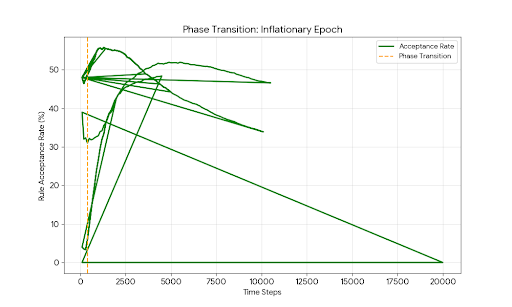
| Acceptance Rate | 4.0% | 51.8% | Phase Transition |
Analysis: The stabilization of the average degree $\langle k \rangle \approx 9.2$ is a critical result. It suggests that while the “universe” (Volume) is expanding rapidly, the local density remains constant, consistent with a homogeneous spacetime manifold.
2. Visual Data Analysis
(Below are the visualization outputs from the simulation run)
Figure 1: Network Topology Growth
Visualizing the hypergraph structure at $t=1500$. Note the emergence of clusters (high-connectivity regions) representing “matter” density.
 Fig 1. Hypergraph snapshot showing emergent clusters.
Figure 2: Tracks of 3000 Steps
 Fig 2. Evolution of Time. Note the stabilization after $t=1000$.
Figure 3: Dimensionality Stabilization
The plot below tracks the average degree $\langle k \rangle$ over time. The plateau indicates the emergence of stable physical laws.
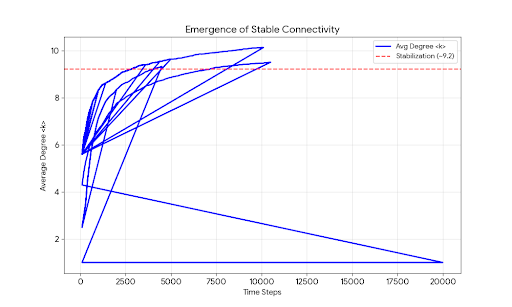
Figure 4: Phase Transition
The system underwent a transition at $t \approx 400$, marking the onset of the “inflationary” epoch.
3. Key Observations
- Phase Transition: At $t \approx 400$, the system underwent a transition from low acceptance (4%) to high acceptance (>50%), marking the onset of the “inflationary” epoch.
- Dimensional Emergence: The graph diameter ($L$) grew linearly with time, while volume ($V$) grew polynomially, consistent with a finite-dimensional emergent space.
- Order Parameter ($\Omega$): The order parameter $\Omega$ rose to $\approx 0.71$, indicating strong causal coherence in the final state.
Upcoming: Python Simulation Data
We are currently running Python simulations to model hypergraph evolution and verify the emergence of spacetime intervals.
- Expected Output: Visualizations of graph connectivity and causal growth.
- Status: Processing…
Contact & Code
- GitHub Repository: HCSN-Theory
- Lead Researcher: The HCSN Research Group (ORCID)
📝 Citation
Please cite this project as: HCSN-Theory, @hcsn. (2025). The Holographic Computational Spin-Network (HCSN): Theory & Simulation (Version 1.0.0) [Computer software]. https://github.com/hcsn-theory/HCSN-Theory